A gamified wellness app for building sustainable walking habits
StepStage addresses a gap in fitness apps by focusing on sustained motivation rather than step tracking alone. Based on a University of Pennsylvania research study on loss-framed incentives, I designed an experience that helps users build consistent walking habits through structured progression and motivational reinforcement. The app combines behavioral nudges, emotionally engaging feedback, and clear achievement pathways to transform walking into a meaningful and rewarding experience. By balancing extrinsic triggers with intrinsic motivation, StepStage supports long-term behavior change and sustainable habit formation.
StepStage
Role
Product Designer
Project
Academic
Platform
Mobile
Timeline
May 2025 - July 2025
StepStage
A gamified wellness app for building sustainable walking habits
StepStage addresses a gap in fitness apps by focusing on sustained motivation rather than step tracking alone. Based on a University of Pennsylvania research study on loss-framed incentives, I designed an experience that helps users build consistent walking habits through structured progression and motivational reinforcement. The app combines behavioral nudges, emotionally engaging feedback, and clear achievement pathways to transform walking into a meaningful and rewarding experience. By balancing extrinsic triggers with intrinsic motivation, StepStage supports long-term behavior change and sustainable habit formation.
Role
Product Designer
Project
Academic
Platform
Mobile
Timeline
May 2025 - July 2025
StepStage
A gamified wellness app for building sustainable walking habits
StepStage addresses a gap in fitness apps by focusing on sustained motivation rather than step tracking alone. Based on a University of Pennsylvania research study on loss-framed incentives, I designed an experience that helps users build consistent walking habits through structured progression and motivational reinforcement. The app combines behavioral nudges, emotionally engaging feedback, and clear achievement pathways to transform walking into a meaningful and rewarding experience. By balancing extrinsic triggers with intrinsic motivation, StepStage supports long-term behavior change and sustainable habit formation.
Role
Product Designer
Project
Academic
Platform
Mobile
Timeline
May 2025 - July 2025
Problem
Despite growing awareness of physical health, many adults especially those with sedentary lifestyles struggle to maintain consistent walking habits. Most fitness apps focus on tracking data but lack emotional triggers and accountability systems needed to sustain motivation.
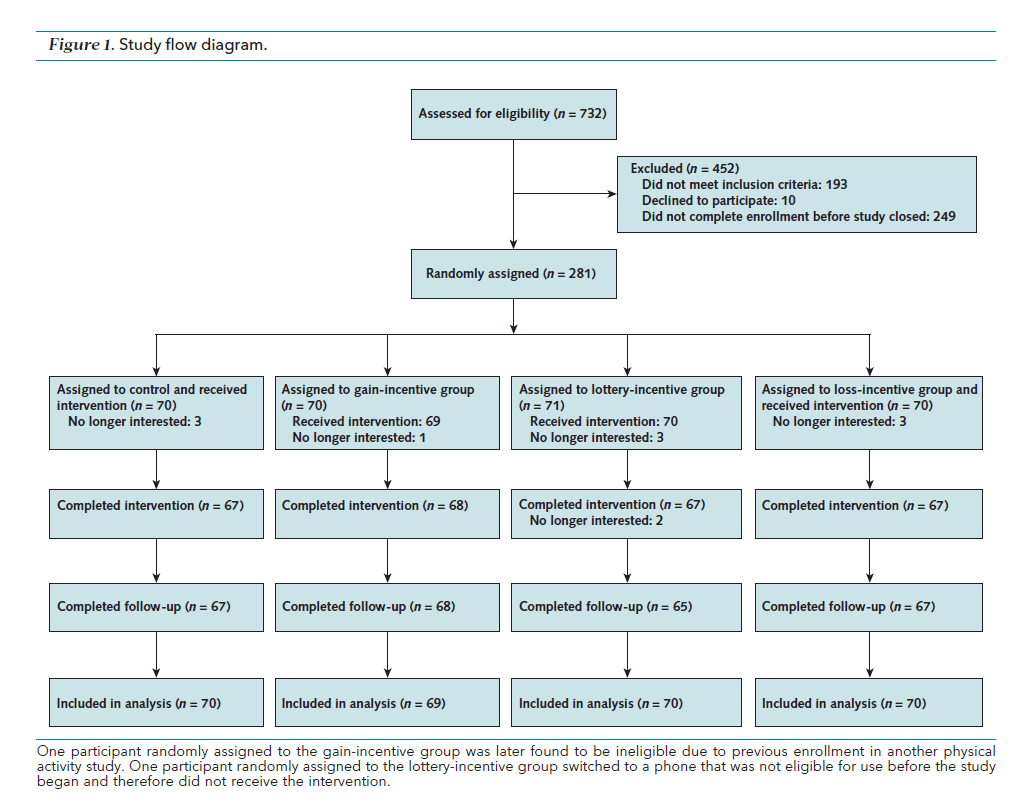
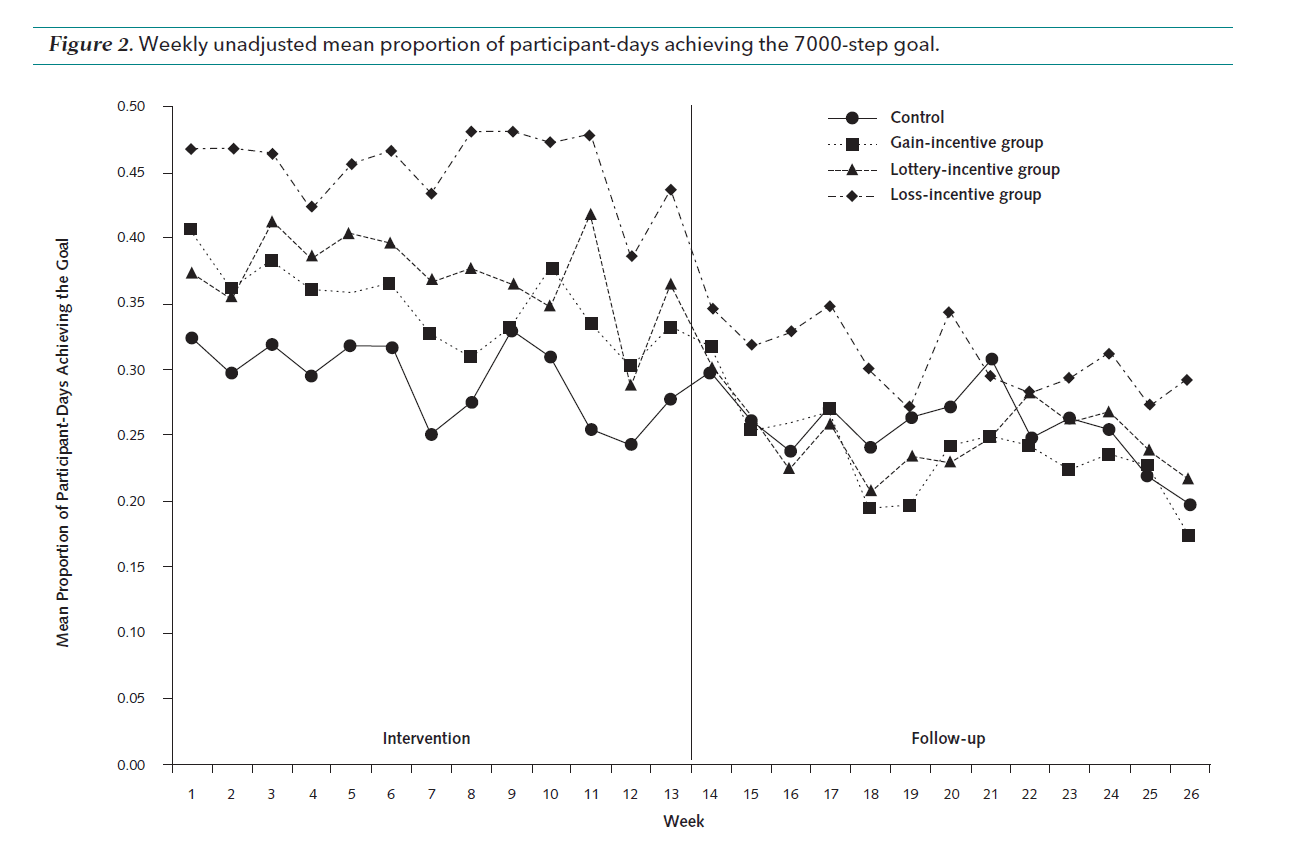
A 26 week randomized controlled trial by the University of Pennsylvania tested different financial incentive models to increase daily step counts. The loss framed model, where participants were given money upfront and lost it if they missed goals, achieved the highest adherence rate at 45 percent. However, once incentives ended, activity levels declined across all groups.
Insight: Loss aversion drives short term action, but it does not build long term behavioral identity.
The intervention was effective, yet motivationally unbalanced. It relied heavily on extrinsic pressure and lacked intrinsic reinforcement.
The opportunity was not to change the incentive, but to redesign the experience around it.
Solution
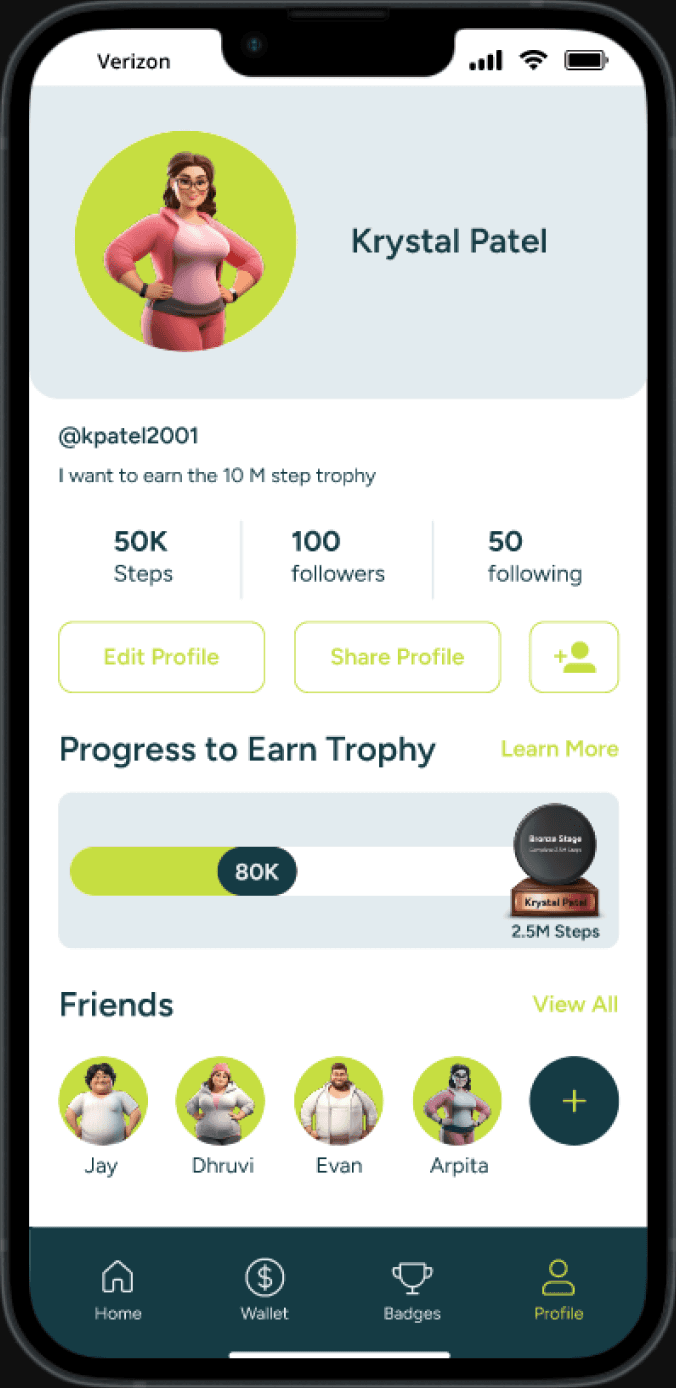
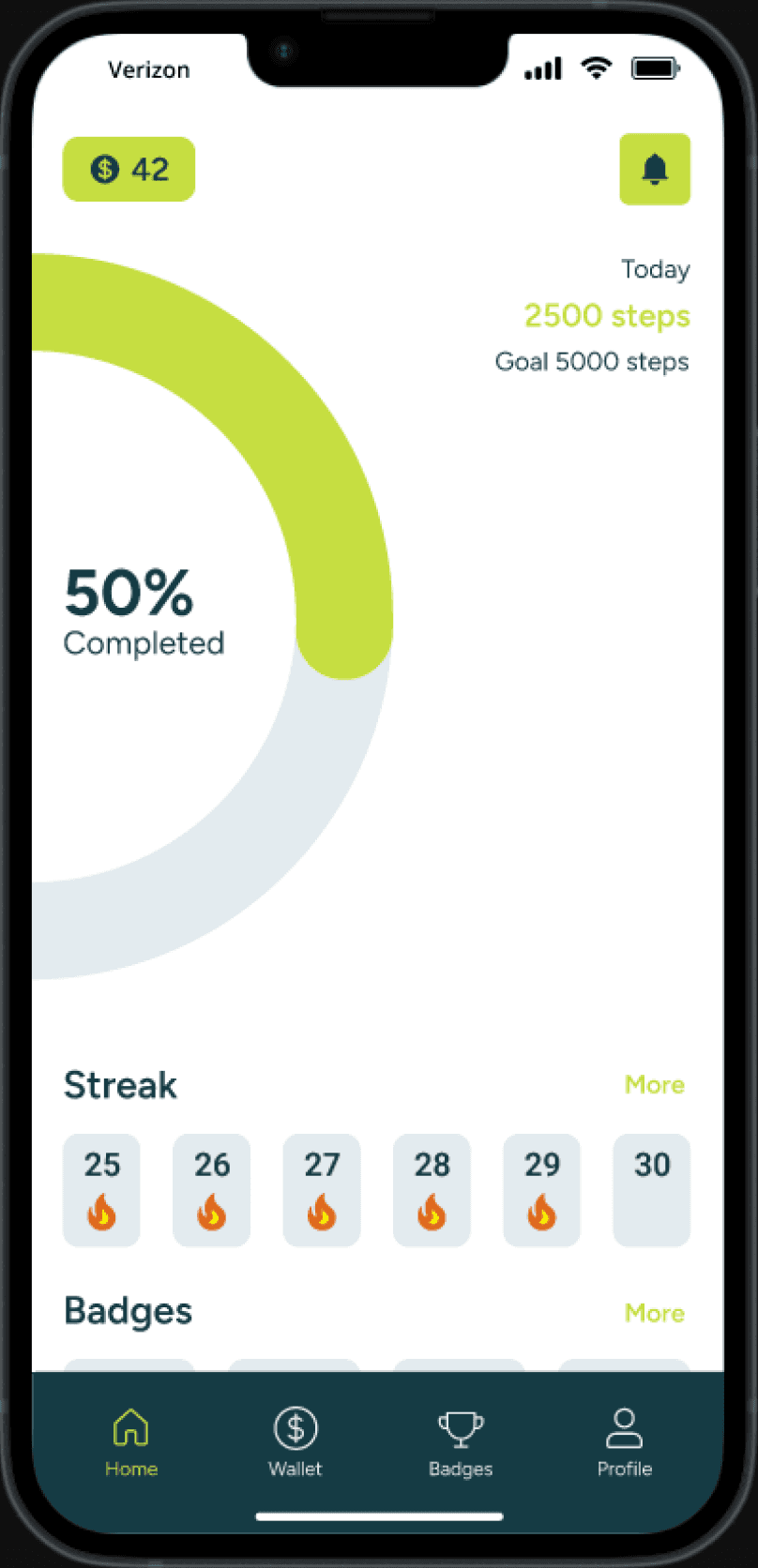
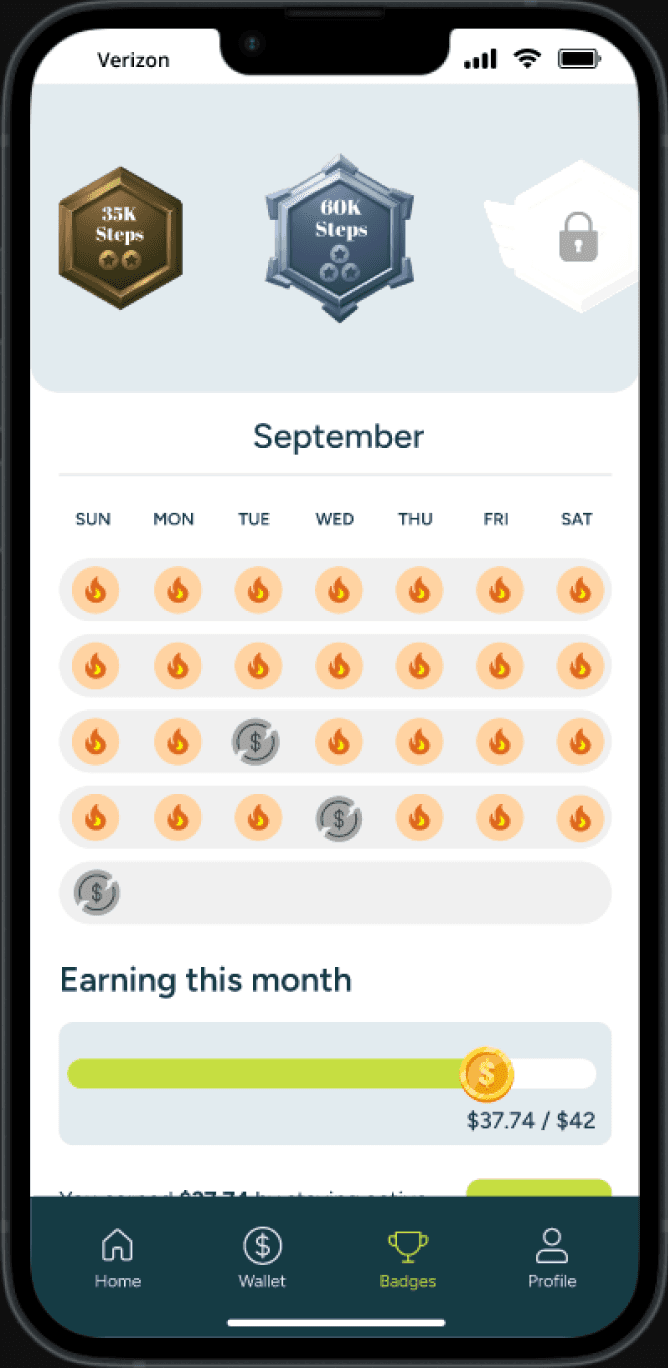
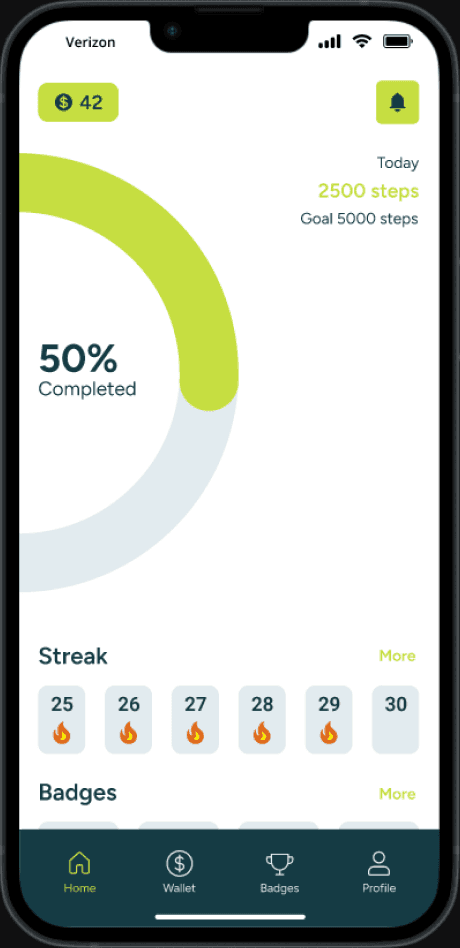
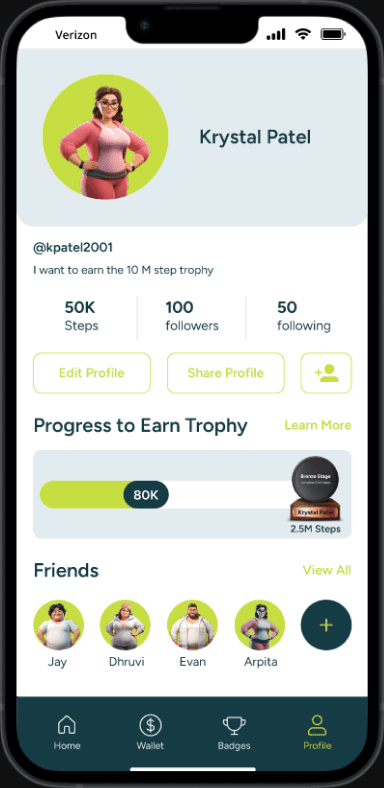
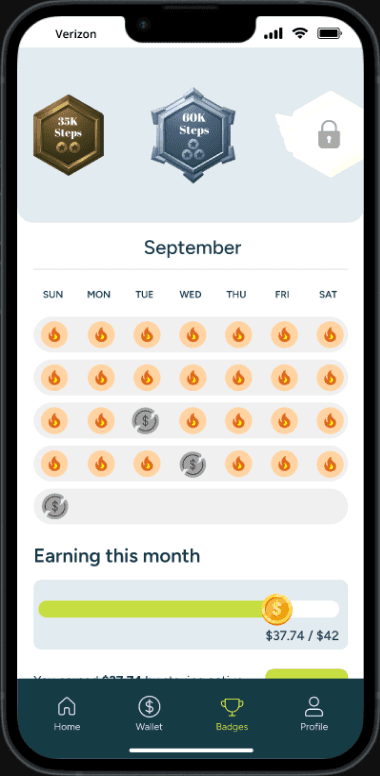
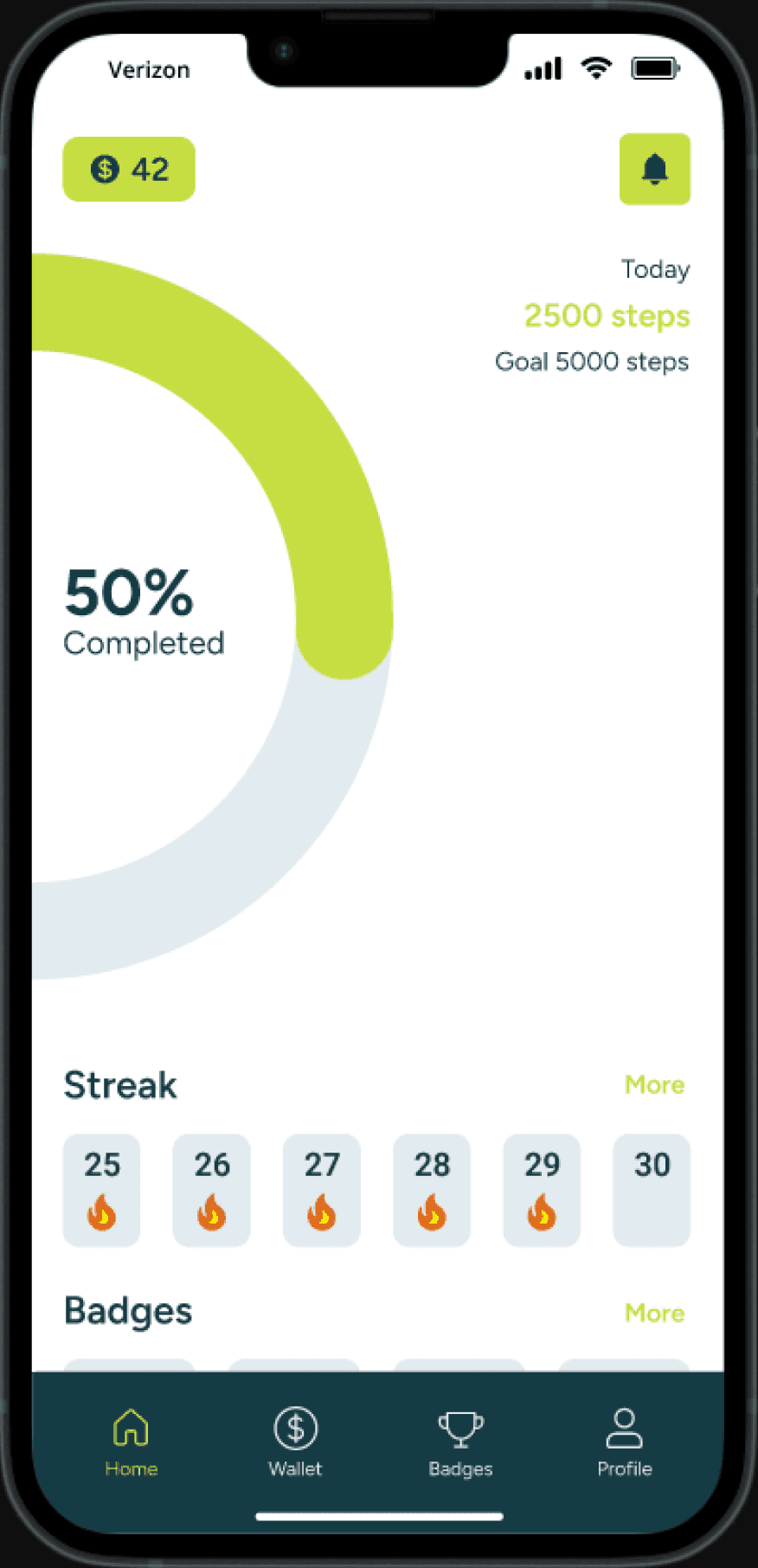
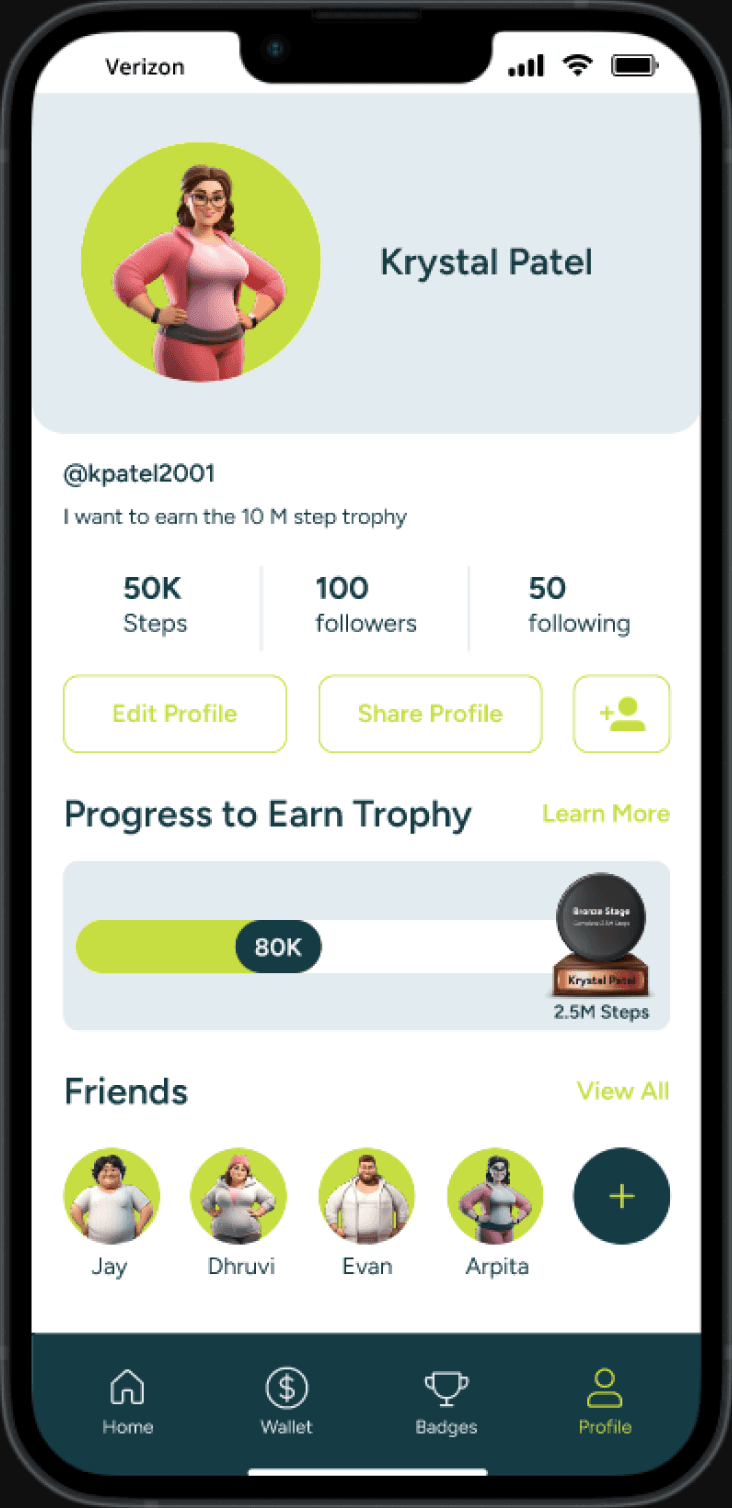
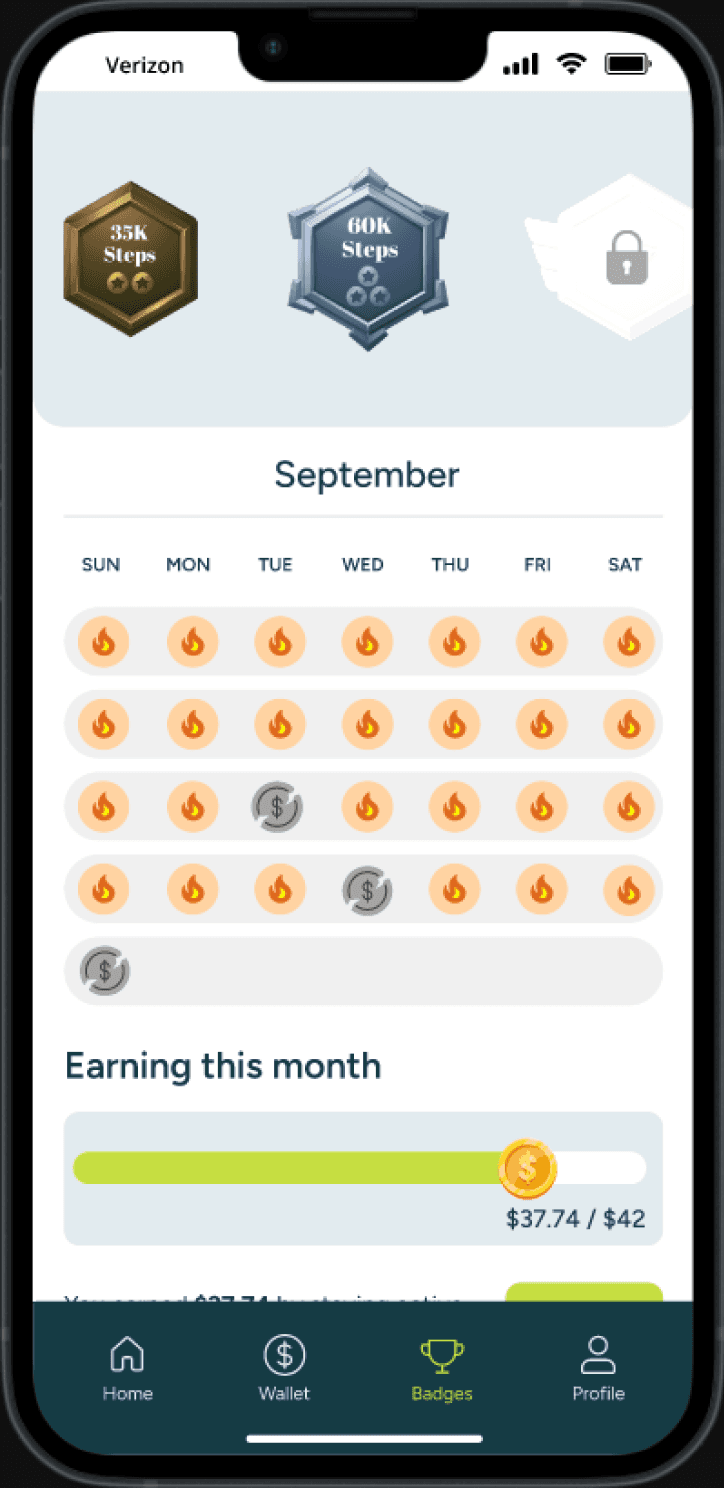
StepStage is a gamified mobile app that uses behavioral nudges, loss framed incentives, habit loops, and player motivation models to help users build sustainable walking routines. It transforms health goals into engaging, game like missions that feel emotionally rewarding and psychologically effective.
I designed StepStage to translate a research backed incentive model into a structured motivational system.
Strategic Design Decisions
Retained loss aversion as a behavioral trigger
Balanced it with intrinsic motivation such as competence and autonomy
Introduced structured progression from Discovery to Endgame
Selected a data driven Rockstar persona based on motivational analysis
Designed reinforcement loops beyond financial stakes
Applied Octalysis to rebalance White Hat and Black Hat drivers
View Prototype
Impact and Result
Motivational Impact
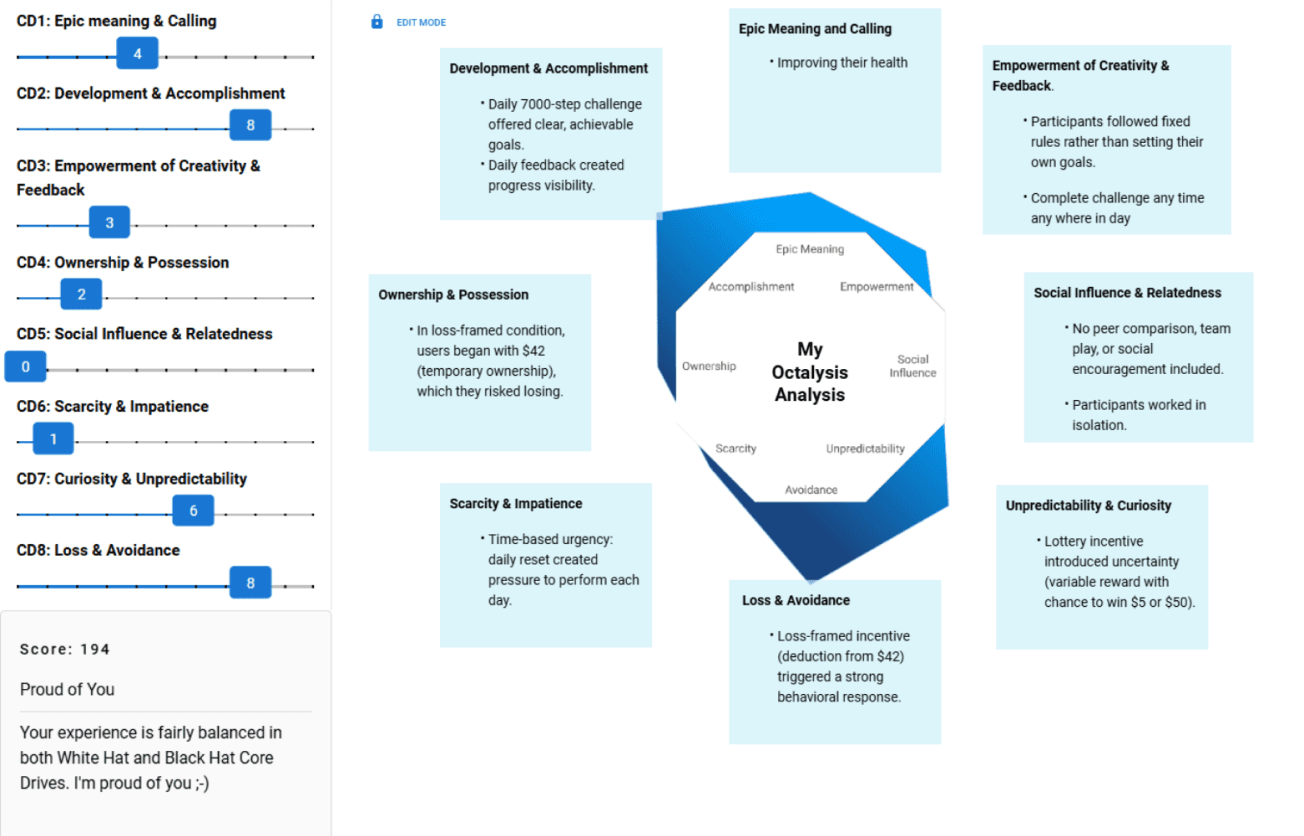
Before (Research Model):
Strong Loss & Avoidance
Strong Accomplishment
Weak Ownership
No Social Influence
Heavy Black Hat motivation
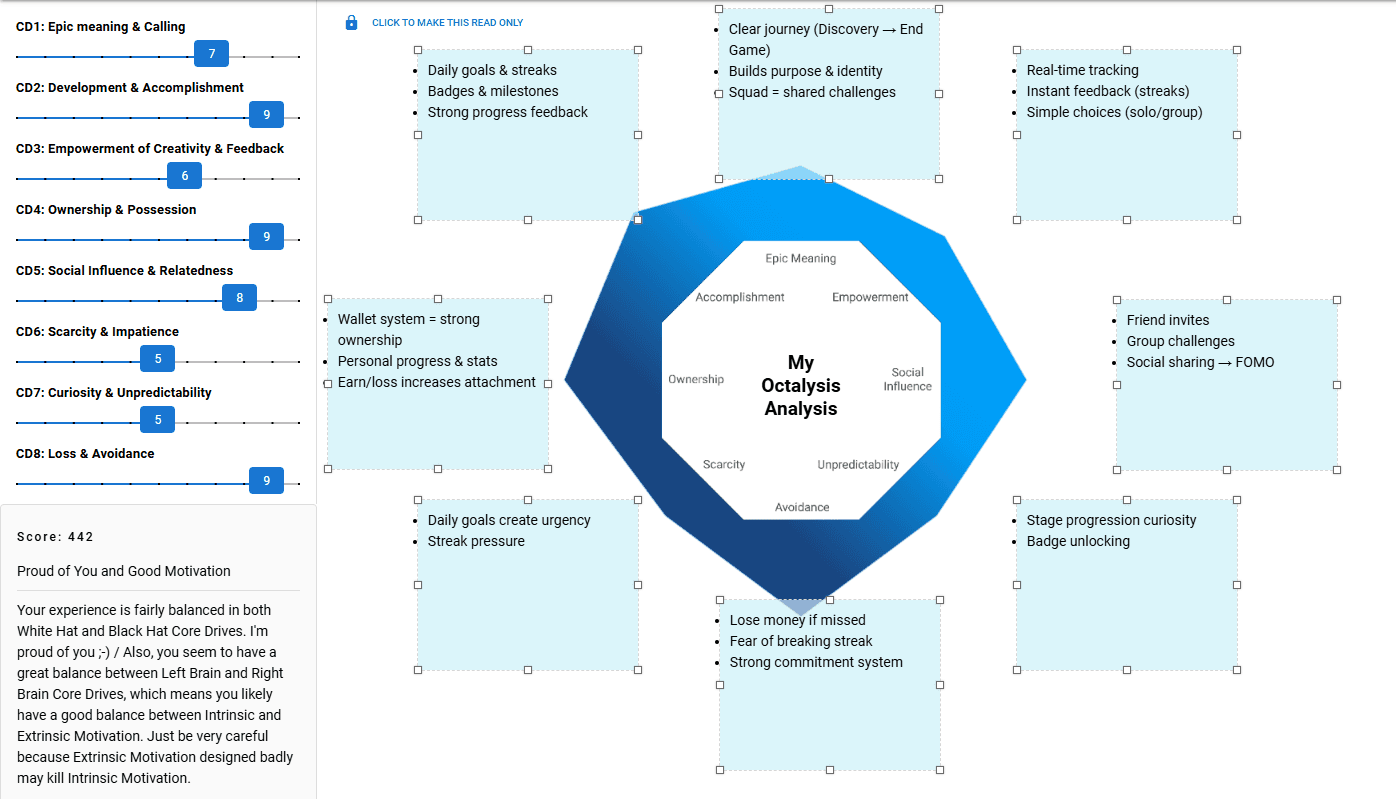
After (StepStage):
Balanced Loss & Accomplishment
Increased Ownership through streaks
Structured progression journey
Greater Autonomy
Strengthened intrinsic reinforcement
Behavioral Impact
Maintains short-term effectiveness of loss aversion
Reduces motivational drop-off through intrinsic layering
Strengthens sense of competence and ownership
Encourages habit internalization beyond incentives
Design Process
Research & Behavioral Insights
Studied the UPenn RCT on gamified incentives
Compared loss-framed vs. gain-framed vs. lottery systems
I studied the research paper in depth to understand:
Study structure (26 weeks, 4 groups)
Behavioral framing (gain vs loss vs lottery)
Drop-off patterns after intervention
Psychological drivers behind adherence
Key insight:
Loss aversion works, but does not sustain behavior without intrinsic support.
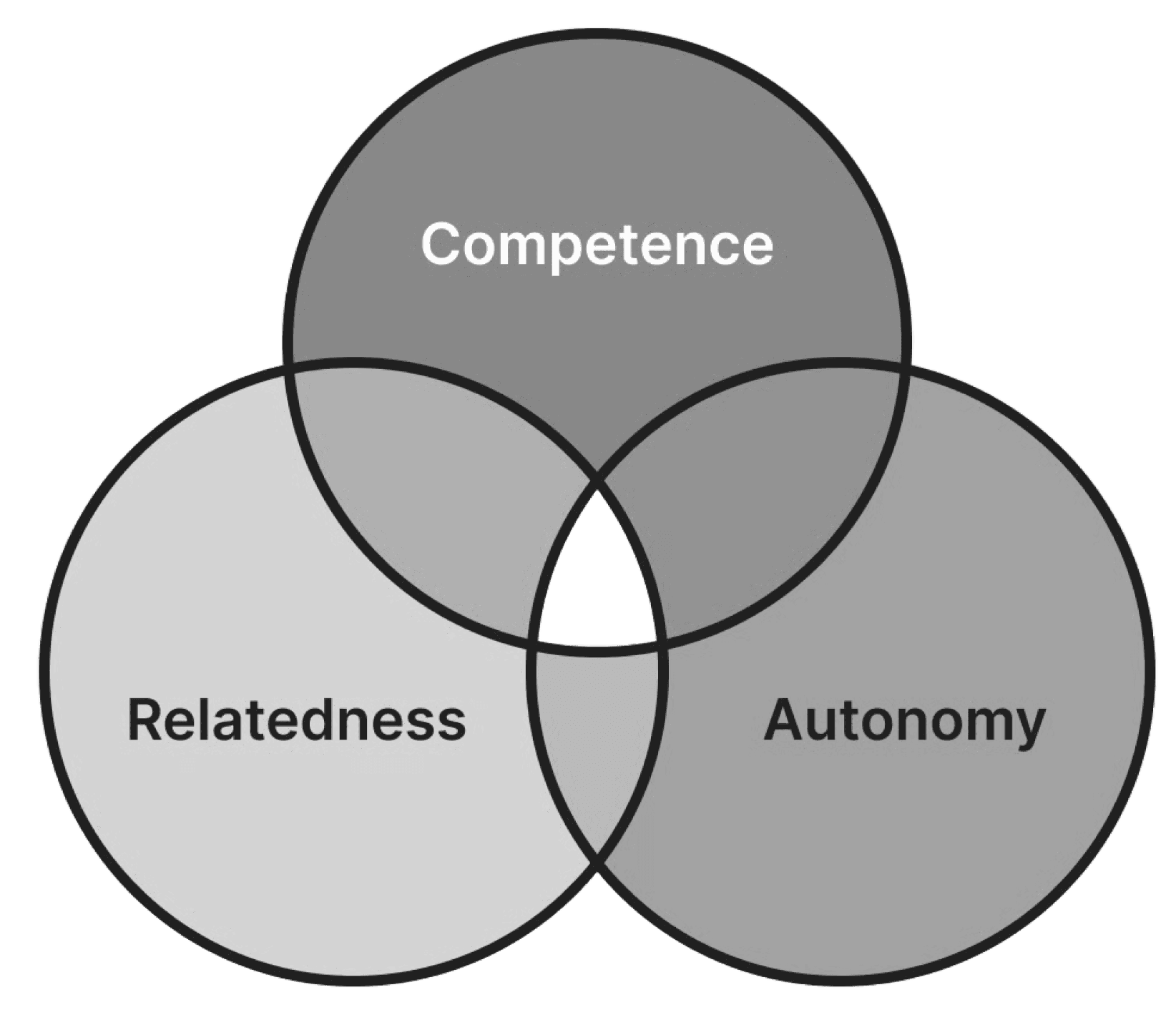
Intrinsic Motivation Mapping – Self-Determination Theory (SDT)
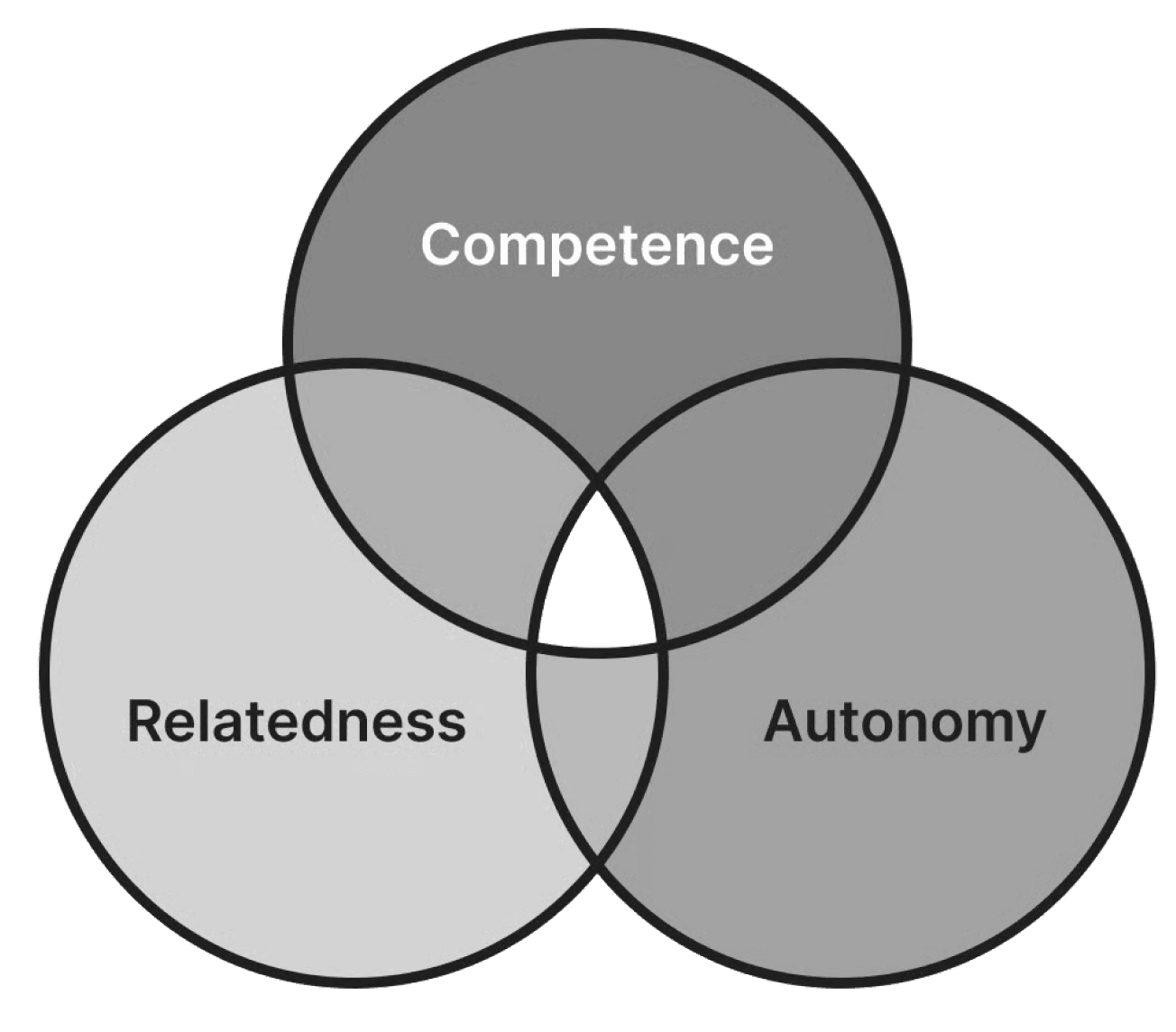
I mapped the findings of the UPenn research paper to Self-Determination Theory to identify how its incentive structures could address three core psychological needs — Competence, Relatedness, and Autonomy — in my app design.
Social Boost: Completing challenges in shared environments (e.g., workplace) can spark peer encouragement
Confidence Grows: Visible progress reinforces self-belief, especially in users starting from low activity levels
Goal Mastery: Achieving the 7000-step goal repeatedly strengthens confidence and skill
Learning Skills: Adapting daily routines to include more walking
Freedom to walk when and how users choose
Flexibility to adapt activity to personal schedules
Extrinsic Motivation
Daily Financial Incentives for performance
Loss Aversion Penalties for missed goals
Lottery Rewards introducing unpredictability and excitement
Feedback based on daily performance
Employer-Backed Goals for public health improvement
Rewards System
Type
Examples
$25 sign-up bonus, $75 after 13 weeks, $1.40/day for goal completion, up to $50/day lottery prizes, $42/month deducted for missed goals
Improved health outcomes, long-term behavior change, daily feedback, motivation from consistent performance metrics
Tangible Rewards
Intangible Rewards
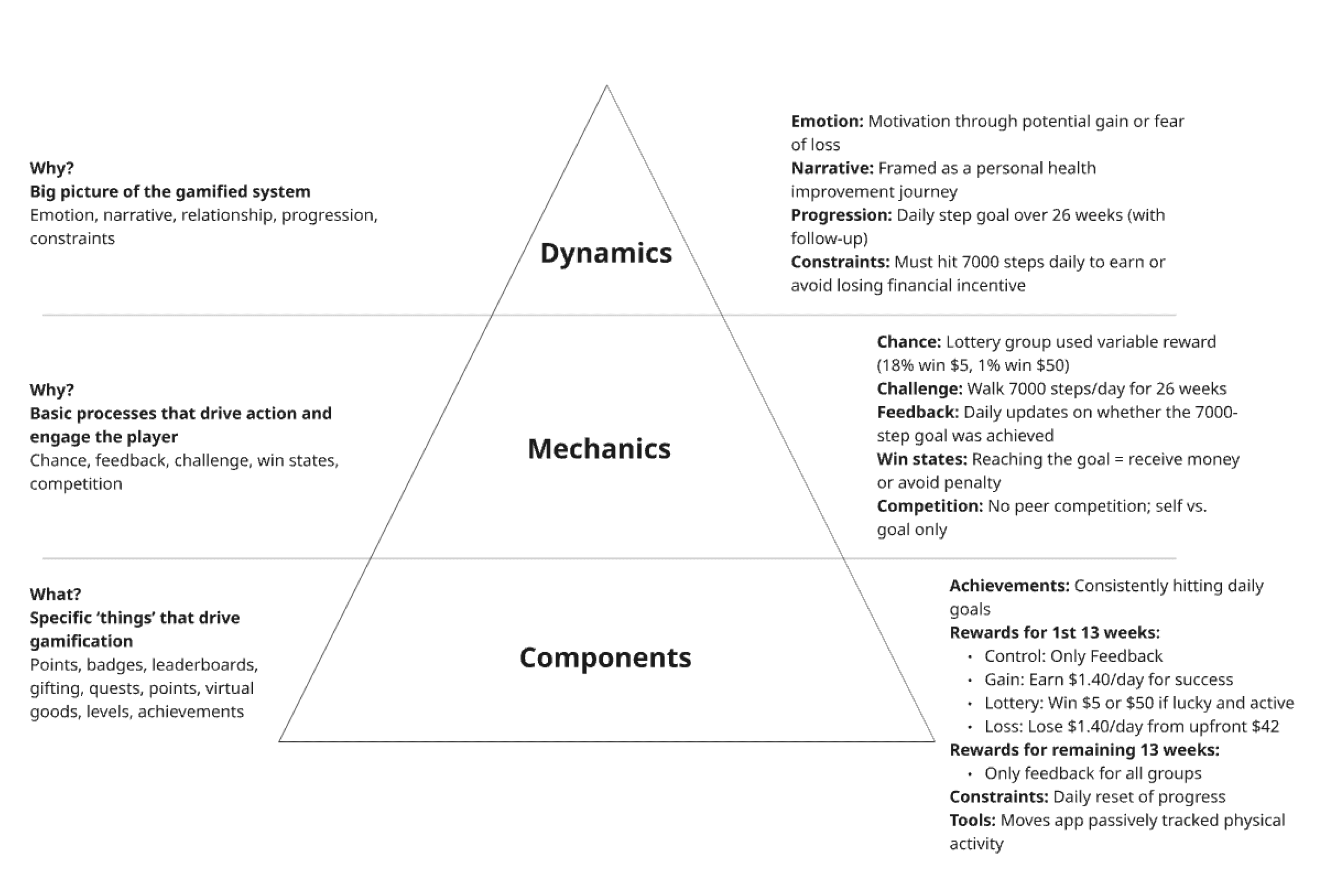
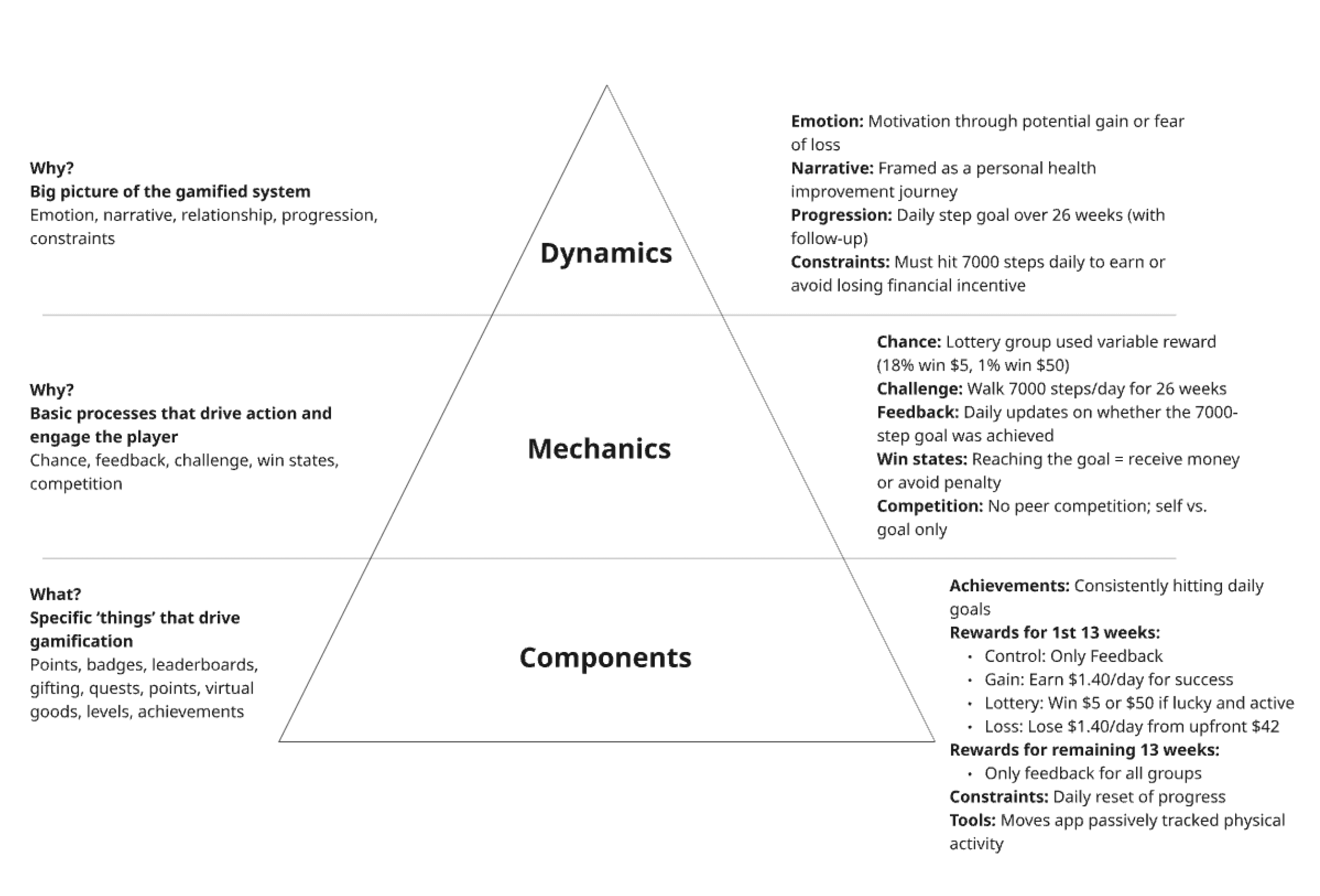
Game Element Pyramid Analysis
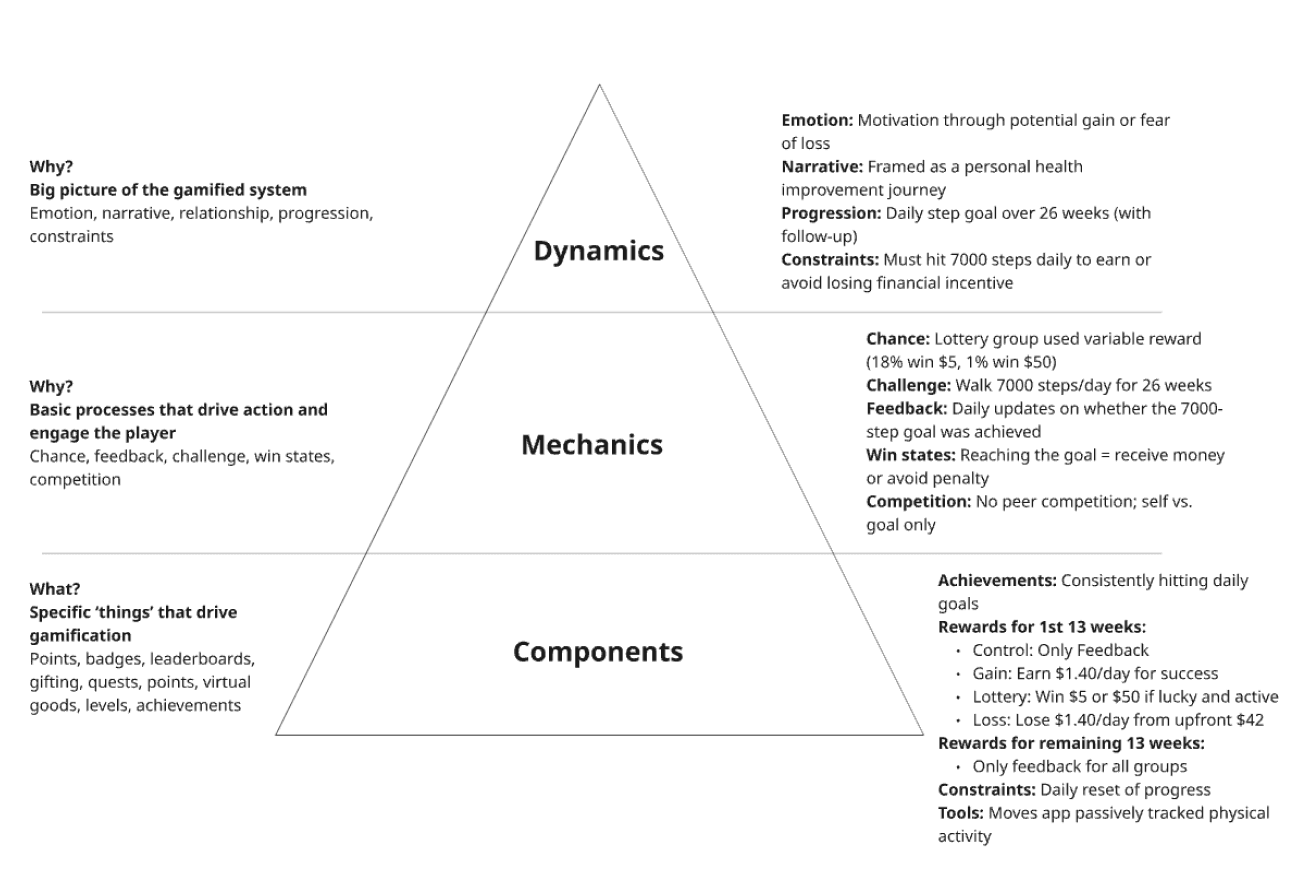
Before designing UI, I deconstructed the intervention into:
Dynamics - Big picture of the gamified system
Emotion, narrative, relationship, progression, constraints
Mechanics - Basic processes that drive action and engage the player
Challenge loop, daily reset, win/loss states, variable rewards
Components - Specific ‘things’ that drive gamification
Incentives, step tracking, feedback system
This clarified the behavioral structure driving the experiment.
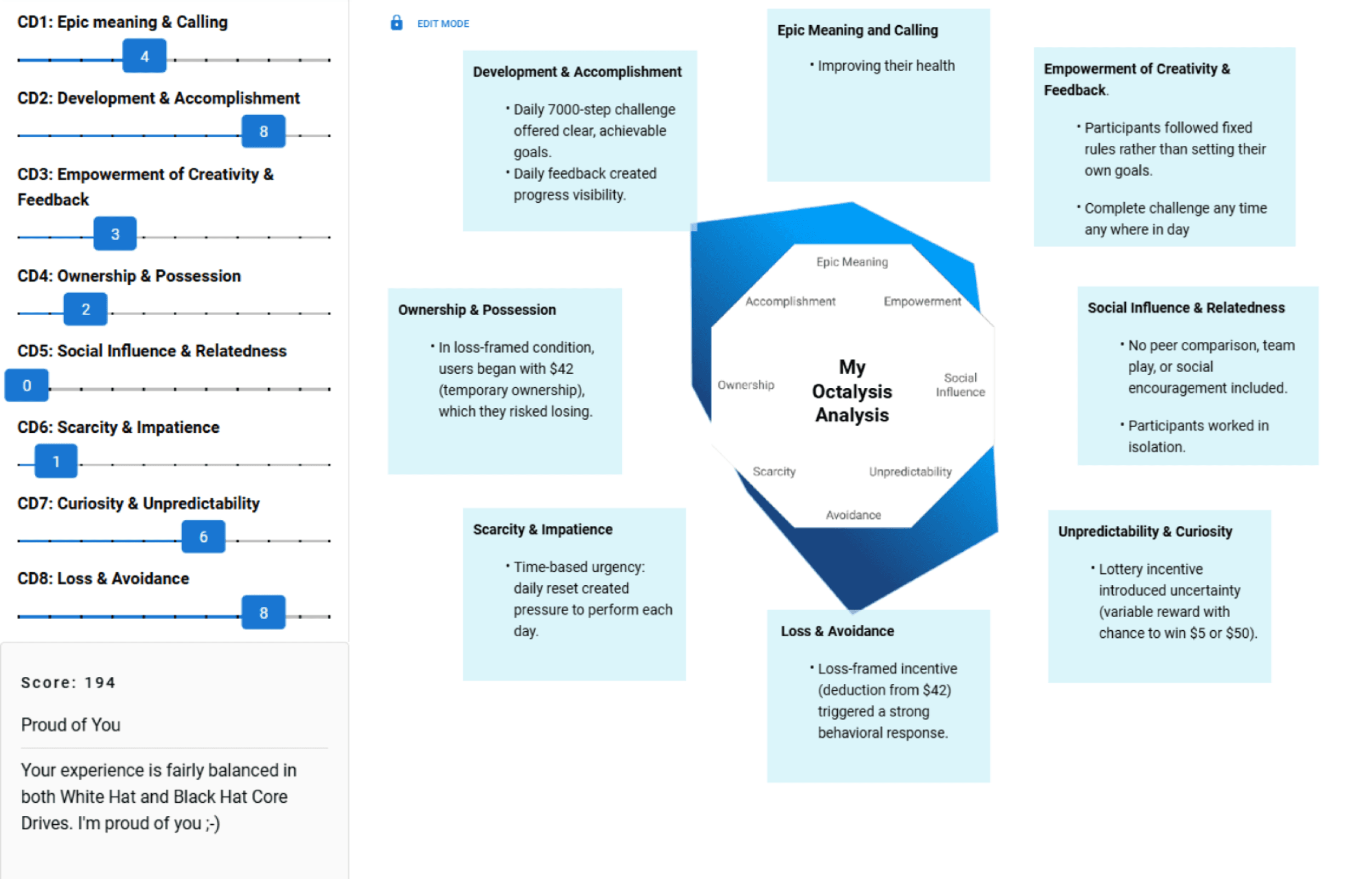
Octalysis Evaluation
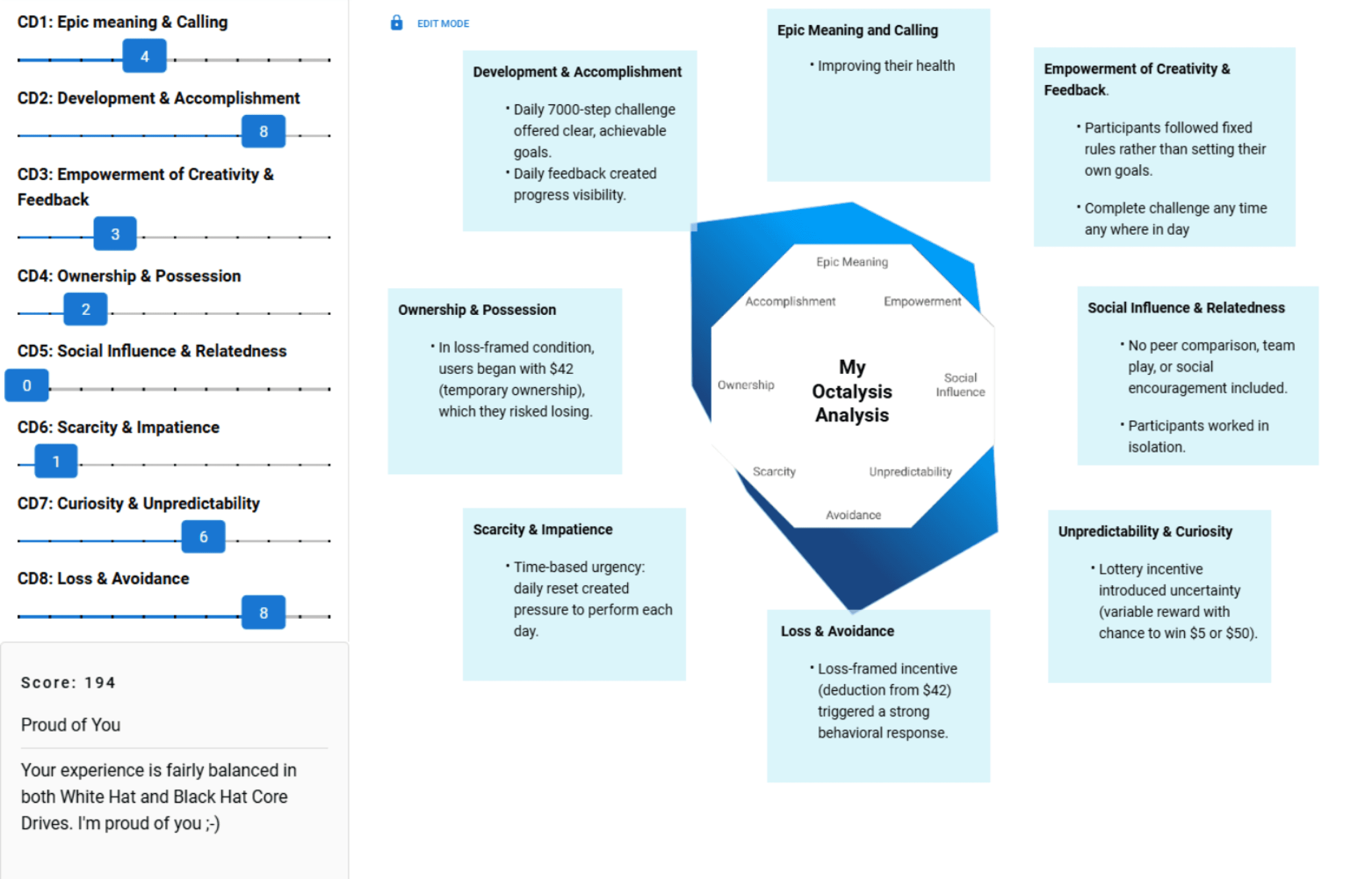
I evaluated the intervention using the Octalysis framework.
Strong Core Drives:
Loss & Avoidance
Development & Accomplishment
Unpredictability
Weak Core Drives:
Ownership
Social Influence
Empowerment
The system was effective but heavily Black Hat-driven (pressure, urgency, fear).
This confirmed the need for balance.
Gamification Framework For Product Design
Define business objectives
The primary objective was not just increasing step counts, but creating sustainable walking behavior.
Key goals:
Improve daily walking consistency
Reduce sedentary lifestyle risk
Increase long-term habit retention
Move beyond short-term incentive compliance
Create a scalable wellness model
This shifted the focus from “step tracking” to “behavior transformation.”
Delineate Target Behaviors
Instead of broad health goals, I defined specific measurable behaviors:
Primary Behavior:
Walk 7000 steps daily
Secondary Behaviors:
Stay consistent for 26 weeks
Maintain streaks
Engage with daily progress feedback
Continue walking beyond incentive period
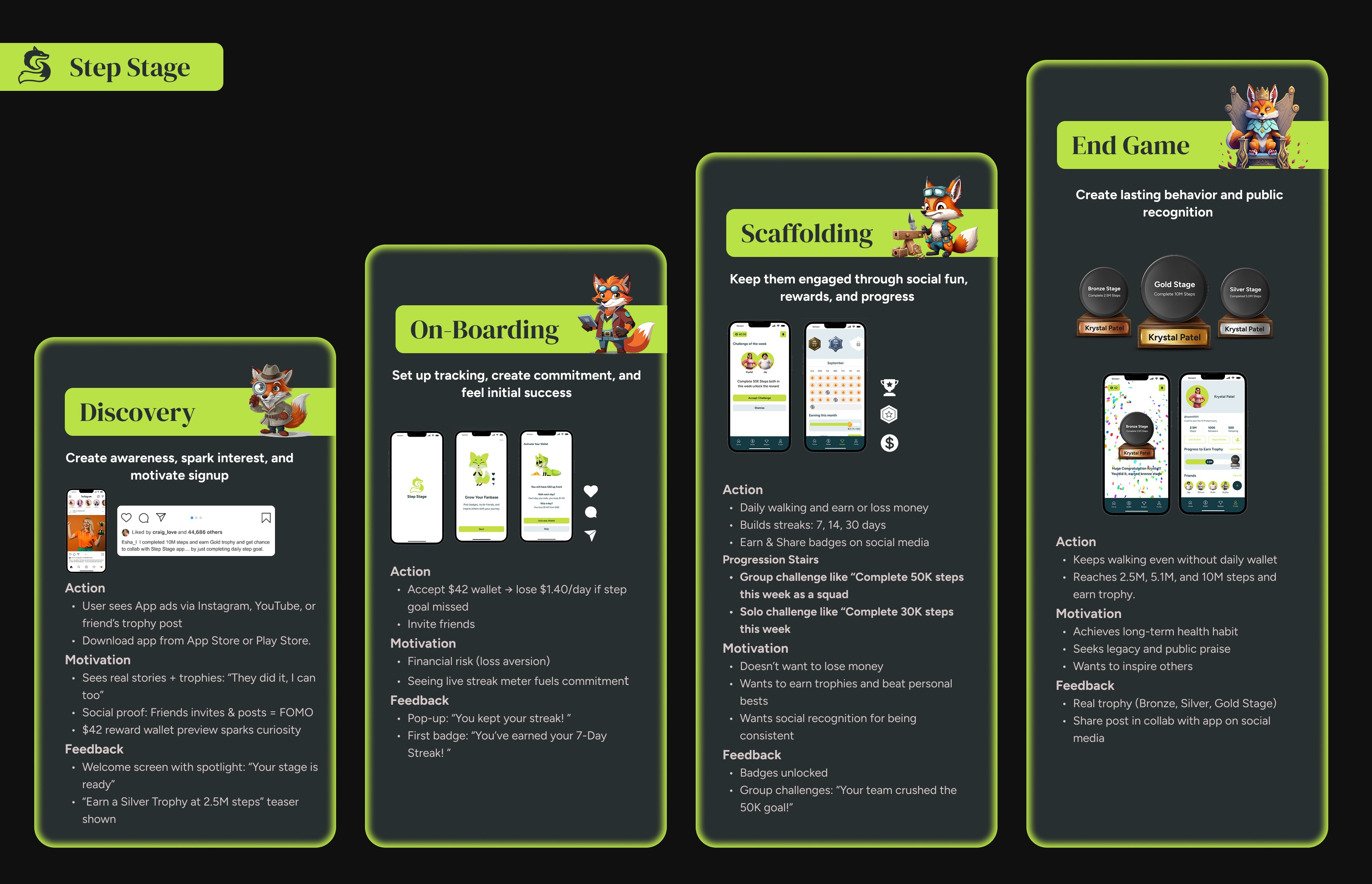
I mapped these behaviors across a 4-stage journey:
Discovery → Onboarding → Scaffolding → Endgame
Each stage gradually increases commitment and habit strength.
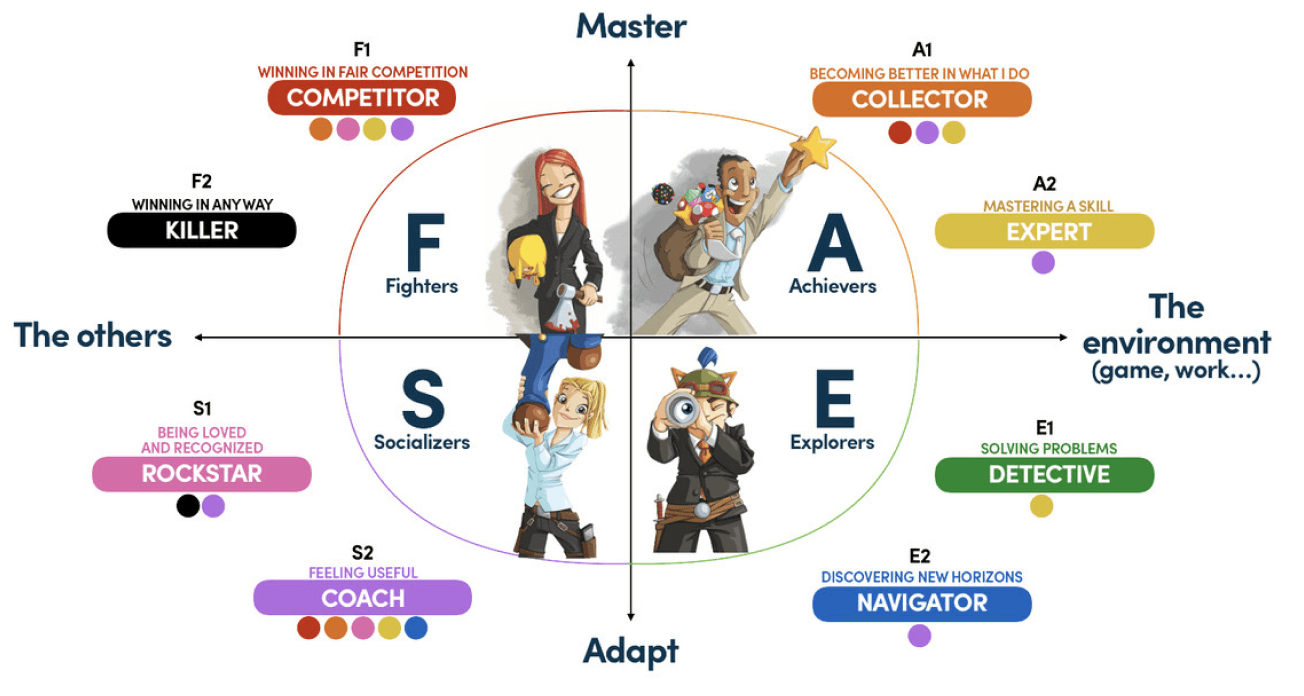
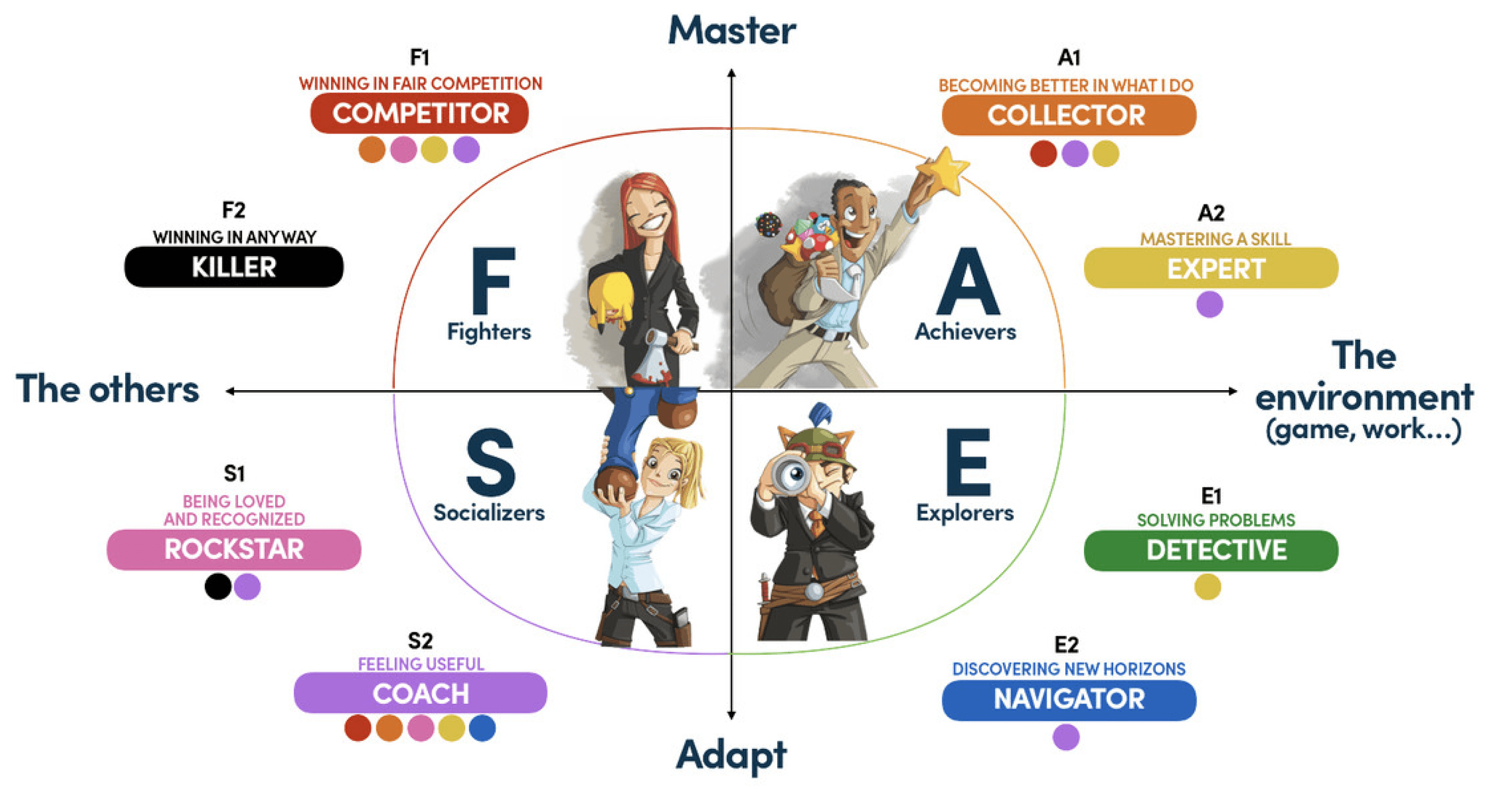
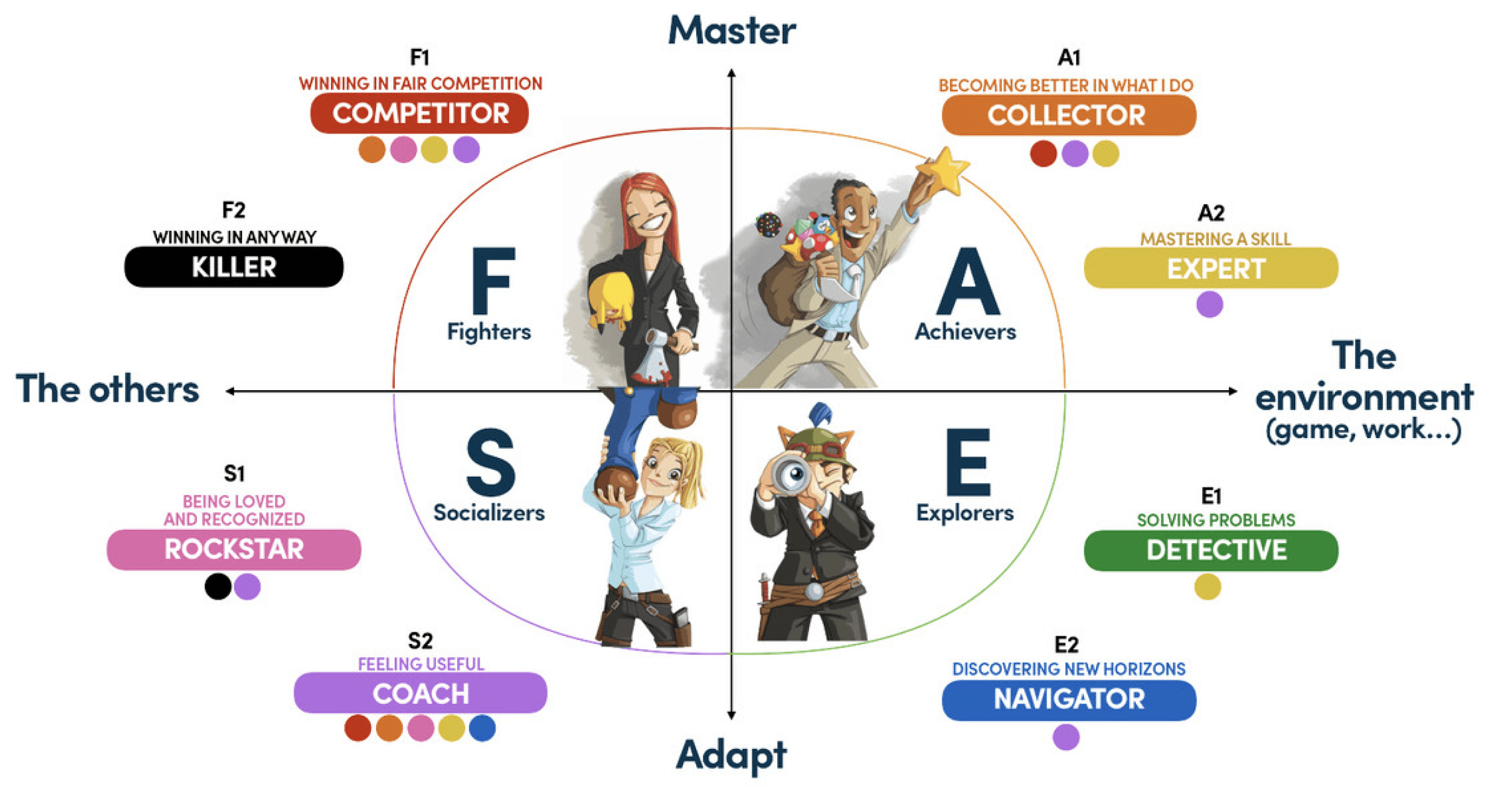
Describe Your Players
Gamification research shows that different users are motivated by different psychological drivers.
Based on my Octalysis analysis, the system strongly activated:
Achievement
Loss avoidance
Structured progression
This aligns with an achievement-driven player type.
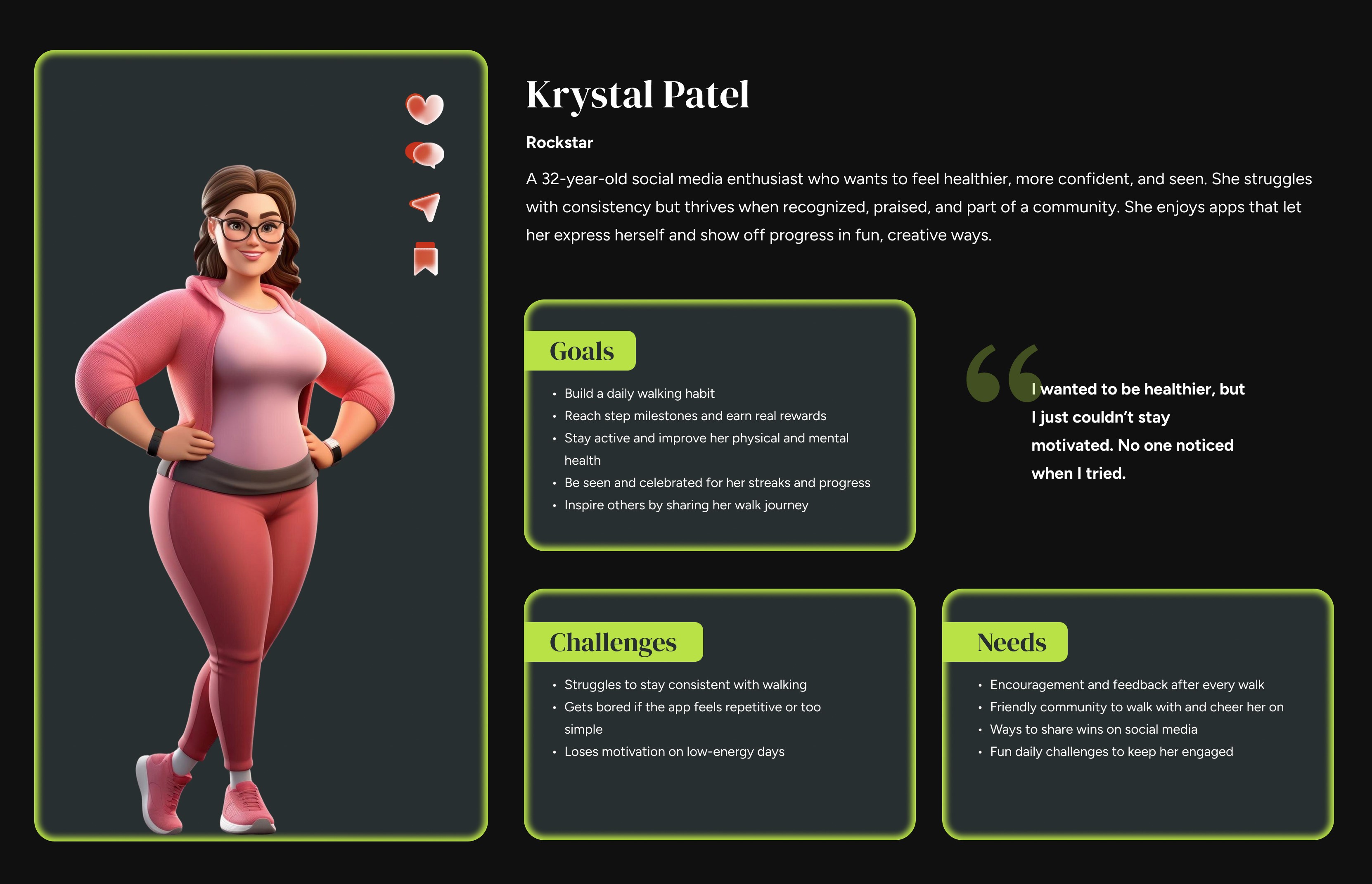
I selected the Rockstar persona:
Goal-oriented
Motivated by measurable progress
Responds to structured challenges
Enjoys mastery and streak systems
Performs well under performance tension
Designing for this persona ensured alignment between the motivational structure and the user profile.
Devise Activities & Progression
I designed engagement loops and progression systems to sustain motivation.
Engagement Loops
Daily Loop:
Walk → Track progress → Receive feedback → Protect incentive → Repeat
Reinforcement Loop:
Complete goal → Strengthen streak → Increase sense of mastery
Motivation Loop:
Risk losing reward → Trigger urgency → Complete challenge → Relief and accomplishment
Progression Stages
Discovery: User understands the challenge and commits to daily walking.
Onboarding: User sets up goal, understands incentive structure, and begins first streak.
Scaffolding: Daily feedback, streak building, and mastery reinforcement strengthen behavior.
Endgame: Focus shifts from financial reward to habit identity and personal accomplishment.
This structured journey ensures behavior moves from external motivation to internalized habit.
Don’t Forget the Fun
To prevent the system from feeling purely pressure-driven, I incorporated light engagement elements:
Progress visualization
Achievement moments
Character driven identity (Rockstar persona)
Emotional reinforcement messages
These elements reduce stress while maintaining motivation.
Deploy Appropriate Tools
Based on the behavioral goals, I deployed:
Reward mechanisms (gain, loss, lottery)
Daily feedback system
Streak psychology
Scarcity through daily reset
Visual progress indicators
Structured milestone system
Each tool was selected intentionally to support specific motivational drivers.
What I Learned
Short term compliance is not long term habit.
Gamification is architecture, not decoration.
Black Hat drivers create urgency, but White Hat drivers sustain retention.
Persona strategy should be derived from motivational analysis.
Research validates behavior. Design transforms it into experience.
Problem
Despite growing awareness of physical health, many adults especially those with sedentary lifestyles struggle to maintain consistent walking habits. Most fitness apps focus on tracking data but lack emotional triggers and accountability systems needed to sustain motivation.
A 26 week randomized controlled trial by the University of Pennsylvania tested different financial incentive models to increase daily step counts. The loss framed model, where participants were given money upfront and lost it if they missed goals, achieved the highest adherence rate at 45 percent. However, once incentives ended, activity levels declined across all groups.
Insight: Loss aversion drives short term action, but it does not build long term behavioral identity.
The intervention was effective, yet motivationally unbalanced. It relied heavily on extrinsic pressure and lacked intrinsic reinforcement.
The opportunity was not to change the incentive, but to redesign the experience around it.
Solution
StepStage is a gamified mobile app that uses behavioral nudges, loss framed incentives, habit loops, and player motivation models to help users build sustainable walking routines. It transforms health goals into engaging, game like missions that feel emotionally rewarding and psychologically effective.
I designed StepStage to translate a research backed incentive model into a structured motivational system.
Strategic Design Decisions
Retained loss aversion as a behavioral trigger
Balanced it with intrinsic motivation such as competence and autonomy
Introduced structured progression from Discovery to Endgame
Selected a data driven Rockstar persona based on motivational analysis
Designed reinforcement loops beyond financial stakes
Applied Octalysis to rebalance White Hat and Black Hat drivers
View Prototype
Impact and Result
Motivational Impact
Before (Research Model):
Strong Loss & Avoidance
Strong Accomplishment
Weak Ownership
No Social Influence
Heavy Black Hat motivation
After (StepStage):
Balanced Loss & Accomplishment
Increased Ownership through streaks
Structured progression journey
Greater Autonomy
Strengthened intrinsic reinforcement
Behavioral Impact
Maintains short-term effectiveness of loss aversion
Reduces motivational drop-off through intrinsic layering
Strengthens sense of competence and ownership
Encourages habit internalization beyond incentives
Design Process
Research & Behavioral Insights
Studied the UPenn RCT on gamified incentives
Compared loss-framed vs. gain-framed vs. lottery systems
I studied the research paper in depth to understand:
Study structure (26 weeks, 4 groups)
Behavioral framing (gain vs loss vs lottery)
Drop-off patterns after intervention
Psychological drivers behind adherence
Key insight:
Loss aversion works, but does not sustain behavior without intrinsic support.
Intrinsic Motivation Mapping – Self-Determination Theory (SDT)
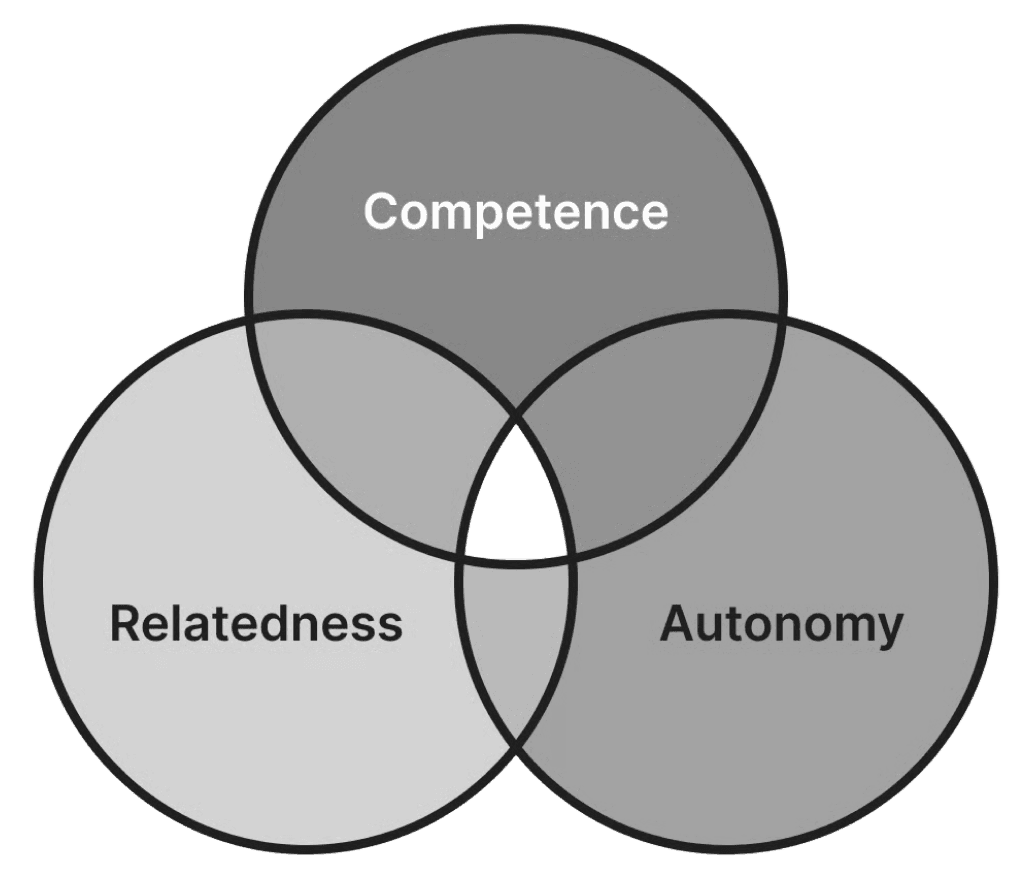
I mapped the findings of the UPenn research paper to Self-Determination Theory to identify how its incentive structures could address three core psychological needs — Competence, Relatedness, and Autonomy — in my app design.
Goal Mastery: Achieving the 7000-step goal repeatedly strengthens confidence and skill
Learning Skills: Adapting daily routines to include more walking
Social Boost: Completing challenges in shared environments (e.g., workplace) can spark peer encouragement
Confidence Grows: Visible progress reinforces self-belief, especially in users starting from low activity levels
Freedom to walk when and how users choose
Flexibility to adapt activity to personal schedules
Extrinsic Motivation
Daily Financial Incentives for performance
Loss Aversion Penalties for missed goals
Lottery Rewards introducing unpredictability and excitement
Feedback based on daily performance
Employer-Backed Goals for public health improvement
Rewards System
Type
Examples
$25 sign-up bonus, $75 after 13 weeks, $1.40/day for goal completion, up to $50/day lottery prizes, $42/month deducted for missed goals
Improved health outcomes, long-term behavior change, daily feedback, motivation from consistent performance metrics
Tangible Rewards
Intangible Rewards
Game Element Pyramid Analysis
Before designing UI, I deconstructed the intervention into:
Dynamics - Big picture of the gamified system
Emotion, narrative, relationship, progression, constraints
Mechanics - Basic processes that drive action and engage the player
Challenge loop, daily reset, win/loss states, variable rewards
Components - Specific ‘things’ that drive gamification
Incentives, step tracking, feedback system
This clarified the behavioral structure driving the experiment.
Octalysis Evaluation
I evaluated the intervention using the Octalysis framework.
Strong Core Drives:
Loss & Avoidance
Development & Accomplishment
Unpredictability
Weak Core Drives:
Ownership
Social Influence
Empowerment
The system was effective but heavily Black Hat-driven (pressure, urgency, fear).
This confirmed the need for balance.
Gamification Framework For Product Design
Define business objectives
The primary objective was not just increasing step counts, but creating sustainable walking behavior.
Key goals:
Improve daily walking consistency
Reduce sedentary lifestyle risk
Increase long-term habit retention
Move beyond short-term incentive compliance
Create a scalable wellness model
This shifted the focus from “step tracking” to “behavior transformation.”
Delineate Target Behaviors
Instead of broad health goals, I defined specific measurable behaviors:
Primary Behavior:
Walk 7000 steps daily
Secondary Behaviors:
Stay consistent for 26 weeks
Maintain streaks
Engage with daily progress feedback
Continue walking beyond incentive period
I mapped these behaviors across a 4-stage journey:
Discovery → Onboarding → Scaffolding → Endgame
Each stage gradually increases commitment and habit strength.
Describe Your Players
Gamification research shows that different users are motivated by different psychological drivers.
Based on my Octalysis analysis, the system strongly activated:
Achievement
Loss avoidance
Structured progression
This aligns with an achievement-driven player type.
I selected the Rockstar persona:
Goal-oriented
Motivated by measurable progress
Responds to structured challenges
Enjoys mastery and streak systems
Performs well under performance tension
Designing for this persona ensured alignment between the motivational structure and the user profile.
Devise Activities & Progression
I designed engagement loops and progression systems to sustain motivation.
Engagement Loops
Daily Loop:
Walk → Track progress → Receive feedback → Protect incentive → Repeat
Reinforcement Loop:
Complete goal → Strengthen streak → Increase sense of mastery
Motivation Loop:
Risk losing reward → Trigger urgency → Complete challenge → Relief and accomplishment
Progression Stages
Discovery: User understands the challenge and commits to daily walking.
Onboarding: User sets up goal, understands incentive structure, and begins first streak.
Scaffolding: Daily feedback, streak building, and mastery reinforcement strengthen behavior.
Endgame: Focus shifts from financial reward to habit identity and personal accomplishment.
This structured journey ensures behavior moves from external motivation to internalized habit.
Don’t Forget the Fun
To prevent the system from feeling purely pressure-driven, I incorporated light engagement elements:
Progress visualization
Achievement moments
Character driven identity (Rockstar persona)
Emotional reinforcement messages
These elements reduce stress while maintaining motivation.
Deploy Appropriate Tools
Based on the behavioral goals, I deployed:
Reward mechanisms (gain, loss, lottery)
Daily feedback system
Streak psychology
Scarcity through daily reset
Visual progress indicators
Structured milestone system
Each tool was selected intentionally to support specific motivational drivers.
What I Learned
Short term compliance is not long term habit.
Gamification is architecture, not decoration.
Black Hat drivers create urgency, but White Hat drivers sustain retention.
Persona strategy should be derived from motivational analysis.
Research validates behavior. Design transforms it into experience.
Problem
Despite growing awareness of physical health, many adults especially those with sedentary lifestyles struggle to maintain consistent walking habits. Most fitness apps focus on tracking data but lack emotional triggers and accountability systems needed to sustain motivation.
A 26 week randomized controlled trial by the University of Pennsylvania tested different financial incentive models to increase daily step counts. The loss framed model, where participants were given money upfront and lost it if they missed goals, achieved the highest adherence rate at 45 percent. However, once incentives ended, activity levels declined across all groups.
Insight: Loss aversion drives short term action, but it does not build long term behavioral identity.
The intervention was effective, yet motivationally unbalanced. It relied heavily on extrinsic pressure and lacked intrinsic reinforcement.
The opportunity was not to change the incentive, but to redesign the experience around it.
Solution
StepStage is a gamified mobile app that uses behavioral nudges, loss framed incentives, habit loops, and player motivation models to help users build sustainable walking routines. It transforms health goals into engaging, game like missions that feel emotionally rewarding and psychologically effective.
I designed StepStage to translate a research backed incentive model into a structured motivational system.
Strategic Design Decisions
Retained loss aversion as a behavioral trigger
Balanced it with intrinsic motivation such as competence and autonomy
Introduced structured progression from Discovery to Endgame
Selected a data driven Rockstar persona based on motivational analysis
Designed reinforcement loops beyond financial stakes
Applied Octalysis to rebalance White Hat and Black Hat drivers
View Prototype
Impact and Result
Motivational Impact
Before (Research Model):
Strong Loss & Avoidance
Strong Accomplishment
Weak Ownership
No Social Influence
Heavy Black Hat motivation
After (StepStage):
Balanced Loss & Accomplishment
Increased Ownership through streaks
Structured progression journey
Greater Autonomy
Strengthened intrinsic reinforcement
Behavioral Impact
Maintains short-term effectiveness of loss aversion
Reduces motivational drop-off through intrinsic layering
Strengthens sense of competence and ownership
Encourages habit internalization beyond incentives
Design Process
Research & Behavioral Insights
Studied the UPenn RCT on gamified incentives
Compared loss-framed vs. gain-framed vs. lottery systems
I studied the research paper in depth to understand:
Study structure (26 weeks, 4 groups)
Behavioral framing (gain vs loss vs lottery)
Drop-off patterns after intervention
Psychological drivers behind adherence
Key insight:
Loss aversion works, but does not sustain behavior without intrinsic support.
Intrinsic Motivation Mapping – Self-Determination Theory (SDT)
I mapped the findings of the UPenn research paper to Self-Determination Theory to identify how its incentive structures could address three core psychological needs — Competence, Relatedness, and Autonomy — in my app design.
Social Boost: Completing challenges in shared environments (e.g., workplace) can spark peer encouragement
Confidence Grows: Visible progress reinforces self-belief, especially in users starting from low activity levels
Goal Mastery: Achieving the 7000-step goal repeatedly strengthens confidence and skill
Learning Skills: Adapting daily routines to include more walking
Freedom to walk when and how users choose
Flexibility to adapt activity to personal schedules
Extrinsic Motivation
Daily Financial Incentives for performance
Loss Aversion Penalties for missed goals
Lottery Rewards introducing unpredictability and excitement
Feedback based on daily performance
Employer-Backed Goals for public health improvement
Rewards System
Type
Examples
$25 sign-up bonus, $75 after 13 weeks, $1.40/day for goal completion, up to $50/day lottery prizes, $42/month deducted for missed goals
Improved health outcomes, long-term behavior change, daily feedback, motivation from consistent performance metrics
Tangible Rewards
Intangible Rewards
Game Element Pyramid Analysis
Before designing UI, I deconstructed the intervention into:
Dynamics - Big picture of the gamified system
Emotion, narrative, relationship, progression, constraints
Mechanics - Basic processes that drive action and engage the player
Challenge loop, daily reset, win/loss states, variable rewards
Components - Specific ‘things’ that drive gamification
Incentives, step tracking, feedback system
This clarified the behavioral structure driving the experiment.
Octalysis Evaluation
I evaluated the intervention using the Octalysis framework.
Strong Core Drives:
Loss & Avoidance
Development & Accomplishment
Unpredictability
Weak Core Drives:
Ownership
Social Influence
Empowerment
The system was effective but heavily Black Hat-driven (pressure, urgency, fear).
This confirmed the need for balance.
Gamification Framework For Product Design
Define business objectives
The primary objective was not just increasing step counts, but creating sustainable walking behavior.
Key goals:
Improve daily walking consistency
Reduce sedentary lifestyle risk
Increase long-term habit retention
Move beyond short-term incentive compliance
Create a scalable wellness model
This shifted the focus from “step tracking” to “behavior transformation.”
Delineate Target Behaviors
Instead of broad health goals, I defined specific measurable behaviors:
Primary Behavior:
Walk 7000 steps daily
Secondary Behaviors:
Stay consistent for 26 weeks
Maintain streaks
Engage with daily progress feedback
Continue walking beyond incentive period
I mapped these behaviors across a 4-stage journey:
Discovery → Onboarding → Scaffolding → Endgame
Each stage gradually increases commitment and habit strength.
Describe Your Players
Gamification research shows that different users are motivated by different psychological drivers.
Based on my Octalysis analysis, the system strongly activated:
Achievement
Loss avoidance
Structured progression
This aligns with an achievement-driven player type.
I selected the Rockstar persona:
Goal-oriented
Motivated by measurable progress
Responds to structured challenges
Enjoys mastery and streak systems
Performs well under performance tension
Designing for this persona ensured alignment between the motivational structure and the user profile.
Devise Activities & Progression
I designed engagement loops and progression systems to sustain motivation.
Engagement Loops
Daily Loop:
Walk → Track progress → Receive feedback → Protect incentive → Repeat
Reinforcement Loop:
Complete goal → Strengthen streak → Increase sense of mastery
Motivation Loop:
Risk losing reward → Trigger urgency → Complete challenge → Relief and accomplishment
Progression Stages
Discovery: User understands the challenge and commits to daily walking.
Onboarding: User sets up goal, understands incentive structure, and begins first streak.
Scaffolding: Daily feedback, streak building, and mastery reinforcement strengthen behavior.
Endgame: Focus shifts from financial reward to habit identity and personal accomplishment.
This structured journey ensures behavior moves from external motivation to internalized habit.
Don’t Forget the Fun
To prevent the system from feeling purely pressure-driven, I incorporated light engagement elements:
Progress visualization
Achievement moments
Character driven identity (Rockstar persona)
Emotional reinforcement messages
These elements reduce stress while maintaining motivation.
Deploy Appropriate Tools
Based on the behavioral goals, I deployed:
Reward mechanisms (gain, loss, lottery)
Daily feedback system
Streak psychology
Scarcity through daily reset
Visual progress indicators
Structured milestone system
Each tool was selected intentionally to support specific motivational drivers.
What I Learned
Short term compliance is not long term habit.
Gamification is architecture, not decoration.
Black Hat drivers create urgency, but White Hat drivers sustain retention.
Persona strategy should be derived from motivational analysis.
Research validates behavior. Design transforms it into experience.